

Update
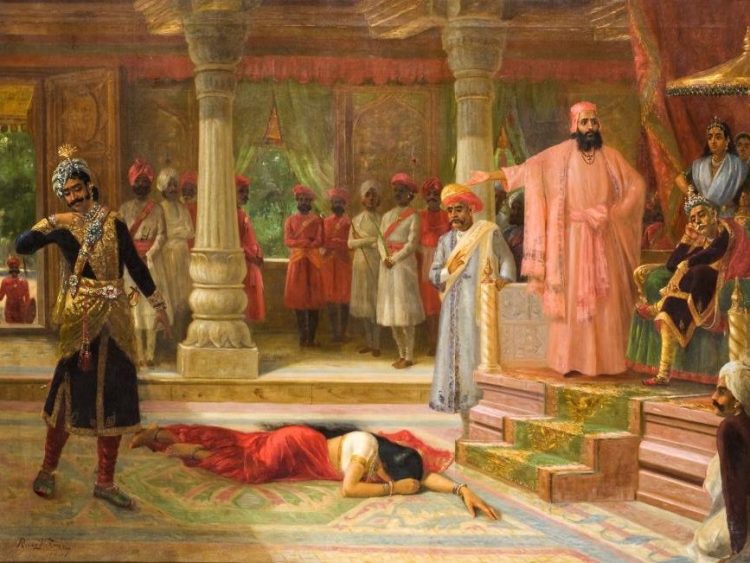
Volume 4: Raja Ravi Varma: An Everlasting Imprint – The Epics Imagined

Volume 4: Raja Ravi Varma: An Everlasting Imprint – The Epics Imagined will be launched on January 31, 2026 at 5:30pm

Raja Ravi Varma: An Everlasting Imprint
This six-volume book-series is the most comprehensive exploration of the influence of Raja Ravi Varma’s image on the religious, social and aesthetic notions of the people of the Indian sub-continent and beyond. It is authored by Ganesh V. Shivaswamy. Three of the six volumes have been released.

Reeling Ravi Varma
Conscious that there is much more to be stated than six-volumes, Instagram reels and YouTube shorts have been put into action to archive these stories and vignettes.
Recent updates
Raja Ravi Varma
Ravi Varma (1848 – 1906) may well be considered the foremost modern Indian artist. Living at a time when India and it’s people were changing in many ways, Varma participated and contributed to the alteration of the Indian aesthetic. Not only was he a highly sought-after portrait artist, painting for the many royal families across India but his depictions of scenes from the Indian epics and puranas also found favor among his patrons.
Born in 1848 in Kilimanoor, an aristocracy in the Kingdom of Travancore, he quickly displayed his artistic talents. He was encouraged by his uncle, Bharani Thirunal Raja Raja Varma and then His Highness Ayilyom Thirunal Rama Varma, the Maharaja of Travancore. Sir Tanjavur Madhava Row, the Dewan of Baroda, introduced him to His Highness Sayajirao Gaekwad – III, the Maharaja of Baroda. What followed was a flood of important commissions including those from the Maharajas of Mysore, Udaipur, Aundh and many others.
The artist, no matter very popular, looked beyond the patron to the public. His participation in the exhibitions including those at Poona, Simla, Madras, Bombay and Calcutta within India and Antwerp, London and Chicago internationally allowed for a larger viewership. The artist was directly instrumental in the establishment of a Picture Gallery at Thiruvananthapuram which is now the Sree Chitra Art Gallery. It is also known that contributions were made during his lifetime to Edgar Thurston who went on to establish a museum for paintings at Madras which is now the Government Museum at Chennai. Many other museums including the Maharaja Fatesingh Museum at Vadodara, the Jayachamarajendra Art Gallery at the Jaganmohan Palace at Mysuru and the Ravi Varma Press Museum at the Hasta Shilpa Heritage Village at Manipal contain his works and those of the Press.
The establishment of the Ravi Varma Press which commenced functioning in 1894 went on to make the artist a household name. The chromolithographs from the Press took art from the privileged domain of patrons to the household of the common man. The artist, his paintings, the museums and chromolithographs from the Press together would leave an indelible mark in the perception of religions imagery and societal aesthetics among the people of the Indian sub-continent and beyond.


and
Raja Ravi Varma
The foundation, established in 2019, works towards continuing an effort which has started as early as in 2006, towards structuring the legacy of the artist. Through a collaboration with Google Arts & Culture and the collective effort of the custodians of his art and legacy, the foundation strives to comprehensively compile the legacy. Beside the online presence, work has been done in curating two museums: the Sree Chitra Art Gallery at Thiruvananthapuram (which is the largest Governmental repository of his works) and the Ravi Varma Press Museum at the Hasta Shilpa Heritage Village at Manipal (which is the largest repository of archival material from the Press). The six-volume book series, Raja Ravi Varma: An Everlasting Imprint, further documents the legacy of the artist. The initiative of taking the legacy into the digital space is Reeling Ravi Varma, a series of Instagram reels and YouTube shorts, is to make the legacy accessible to more and all these efforts would eventually lead to a substantial documentation of the legacy for the future.
Our work on Raja Ravi Varma

Curating the Ravi Varma Press Museum at the Hasta Shilpa Heritage Village, Manipal
The Hasta Shilpa Heritage Village was founded by Shri. Vijayanath Shenoy. In 2003-04 it acquired the archival material from the discontinued Ravi Varma Press and relocated it to the village. The process of re-curating the museum by Ganesh Shivaswamy has commenced in 2024.

Raja Ravi Varma: An Everlasting Imprint
This six-volume book-series is the most comprehensive exploration of the influence of Raja Ravi Varma’s image on the religious, social and aesthetic notions of the people of the Indian sub-continent and beyond. It is authored by Ganesh V. Shivaswamy. Three of the six volumes have been released.

Reeling Ravi Varma
Conscious that there is much more to be stated than six-volumes, Instagram reels and YouTube shorts have been put into action to archive these stories and vignettes.
Curating the Sree Chitra Art Gallery, Thiruvananthapuram
The history of the Sree Chitra Art Gallery at Thiruvananthapuram can be traced as far back as 1895 when a letter was written by Raja Ravi Varma to H. B. Grigg, the British Resident of Travancore suggesting that the capital of the Kingdom of Travancore have a ‘Picture Gallery’. This eventually lead to the inauguration of the ‘Sri Chitralayam’ by His Highness Chithira Thirunal Balarama Varma, the Maharaja of Travancore. This museum was later renamed the Sree Chitra Art Gallery. A new wing was added in 2023 specially dedicated to the artist. The curation of the new wing was undertaken by Ganesh Shivaswamy.

Commemorating 150 years since the commencement of the artist’s professional career
Raja Ravi Varma’s professional career began in 1870 with a painting of a judge of the Mangalore court. This was the portrait of Kizhakkepalat Krishna Menon (Kizhakkepat Ramakrishna Menon). This commission would set the artist on a path of being commissioned by many important patrons including the celebrated Maharajas of Baroda, Mysore, Travancore, Udaipur among other aristocrats and businessmen. 2020 marked 150 years since the commencement and hence the foundation brought together paintings and sketches from various collections onto the Google Arts & Culture platform.

Commemorating 125 years of the start of the Ravi Varma Press
The Ravi Varma Press was started in 1894 with the print titled’ The Birth of Shakuntala’. Initially owned by C. Raja Raj Varma and Govardhandas Khatau Makhanji and later sold to Fritz Schleicher, this Press made prints which made their way into many Indian homes. They went on to alter the very notions of religious imagery and were respected and criticized as they went on to democratize art. Although never owned by the artist, it immortalized him in the minds of the common man and therefore an imperative ingredient of his larger legacy. 2019 was 125 years since the start of the Ravi Varma Press and the Foundation organized many talks across India.

Lectures and Symposia
Ganesh Shivaswamy and the Foundation has participated and organized many lectures and symposia towards exploring the artist’s work and impact.

Academic Writing and Contributions
The link below enlists the various academic articles and contributions

Commemorating the centennial death anniversary of the artist
The artist died in 1906 and in 2006 the first online catalogue of chromolithographs was created marking a start to the process of re-structuring the artist’s immense social impact.
Launch of Google Arts & Culture

Trending on our Social Media
Follow us on Instagram
A Gallery of some of the works of Raja Ravi Varma


Chromolithographs from the Ravi Varma Press


